
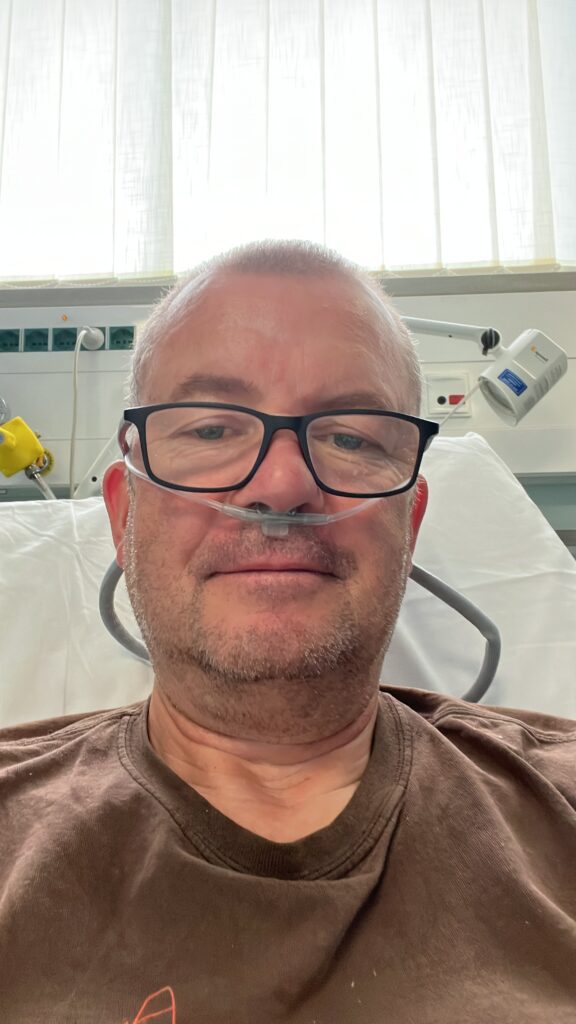
For the past few days, I’ve been confined to a hospital bed in Italy with a life-threatening illness (a DVT with a side-order of double pulmonary thrombosis).
I’ve been very lucky though and I am being released tomorrow but, it’s given me some thinking time. Not just about how a relatively fit persons life and life plans can change in an instant but, leading on from that, the consequences that might lead from that which many people, including myself, never expect to happen to them… well let me tell you, it can and, sometimes, it does.
One of my thoughts, naturally enough was about the what ifs’ had I not been so lucky and what life might look like for me in such a scenario if I had lived but with some of the possible complications that could have arisen from this event.
Those thoughts ranged from my personal mortality, my family and friends to possibly being left partially or severely incapacitated for the rest of my life and what life adjustments I might have to make; as well as the possible accessibility features, I might need. This led me to thinking about the work we do at Ocean 3D and past experiences of trade shows and corporate accessibility talks etc.
Well, I don’t know about you, but I’m often struck how some disabled technologies require very expensive (and thus immediately un-inclusive) technology for end-users to use their products and, when showcasing their services?
Whilst I fully accept that some tech is, by its very nature, high;y specialised, expensive and will always thus be relatively exclusive; my vision for Ocean 3D has always been to provide a low cost solution for every location, that enables each client to provide a free at the point of use service to end users, able and disabled alike. I want our solution to be as accessible and commonplace as the smart device that almost everyone owns and can view our tours on.
I notice this phenomenon most keenly at trade shows, where seemingly no expense is spared to demonstrate the latest gizmo yet, at Ocean 3D, we will rock up at such an event with just a couple of iPads and, if it’s a large location, a normal household tv on a stand with a few printed QR codes on posters. Incidentally, Ocean 3Ds’ entire marketing budget is usually no more than 3 or, occasionally just 4 figures per year.
Why QR codes at shows? QR codes allow passers by to easily access our tours on whatever smart device they have in their pockets or backpack and experience it for real at their own pace and time, without any need to talk to anyone they might assume just wants to sell them something (we won’t ever try to sell you something).
To make a solution truly inclusive and accessible, it must be affordable. For it to be legally compliant with the Equality Act 2010, it must also be provided as an anticipatory need (provided in advance as standard/ built in) or, as a reasonable adjustment (possibly required dependent on a range of considerations including cost v benefit).
For each scenario there is the client and the end-user. The client being the location where the aid might be required and the end-user, being the person who might need to use the technology or service supplied.
In each case, this must be provided free of charge. It is illegal to charge for accessibility features. In the former, the client will want to ensure that they are at least legally compliant and, hopefully, also going above and beyond what is the minimum required in law however, the client will also have cost as a consideration. If a technology cost is to high, the client may be tempted to break the law and not install the tech or, argue that it is not needed.
Whereas if a solution can be provided that is very low-cost, or in the case of our tours cost-negative in many cases, then we believe that this provides a solid foundation for clients to embrace societal accessibility needs. In so doing, accessibility becomes genuinely universal and inclusive.
Thank you for reading.
Chris Wood
Director
Ocean 3D